Strange Flames
The burning side had been quietly waiting for a while.
Not because I had forgotten it.
No, no.
More because I was slightly afraid of it.
The clothing was clear from the beginning: turquoise. That part had already been decided, changed, questioned, abandoned, rescued, and finally accepted again. So at least one thing was certain.
Everything else?
Not so much.
At first, I interpreted the shapes coming out of the vessel in the middle of the card — and the forms growing up from the ground — as flames. It made sense in my head. Fire side, dramatic movement, heat, energy. Obviously: flames.
So I tried to paint them as fire.
Several times.
And every time, they looked… strange.
Not dramatic-strange. Not artistic-strange. More like “something is definitely happening here, but nobody is quite sure what” strange.
At first, I assumed it was me. Which, to be fair, is usually a safe assumption when painting experiments go wrong.
Maybe the orange was too flat. Maybe the transitions were too harsh. Maybe the shape was not flame-like enough. Maybe I was overthinking it. Maybe I was underthinking it. Maybe I should have watched just one more YouTube video, because surely the next one would magically solve everything.
But the more I looked at it, the more I felt that the problem was not only my painting.
The shapes simply did not really want to be flames.
They had movement, yes. They had energy. But instead of looking like fire, they looked forced. As if I was trying to convince the model to become something it did not want to be.
And miniatures can be very stubborn when they have already decided what they are.
So there I was, staring at the fire side of Temperance, with turquoise clothing in my mind, questionable flame experiments, and the slowly growing suspicion that I might have to rethink the whole idea.
Again.
Because apparently this project was not about painting a figure.
It was about learning how many times one person can change a concept before completely losing the plot.
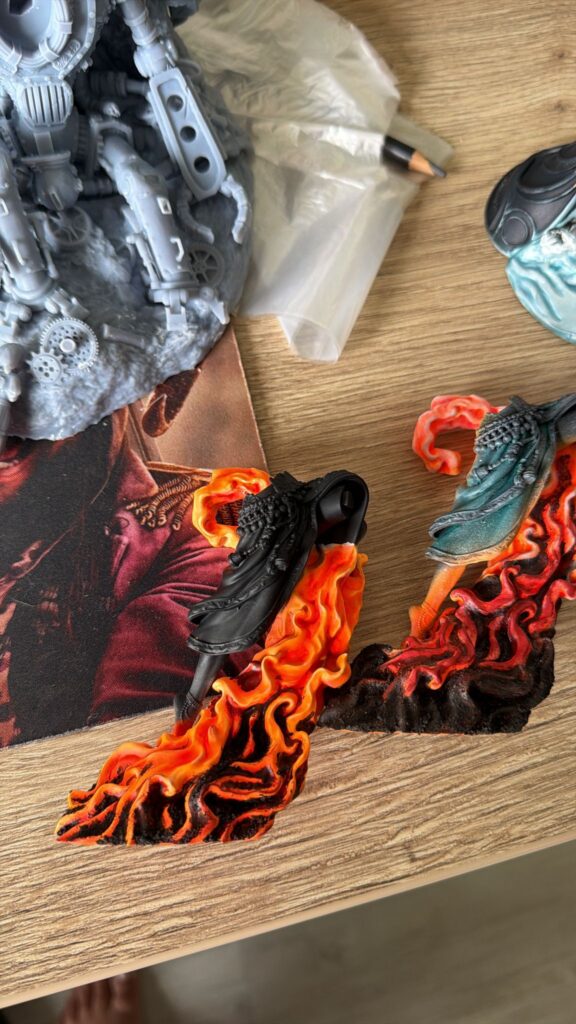
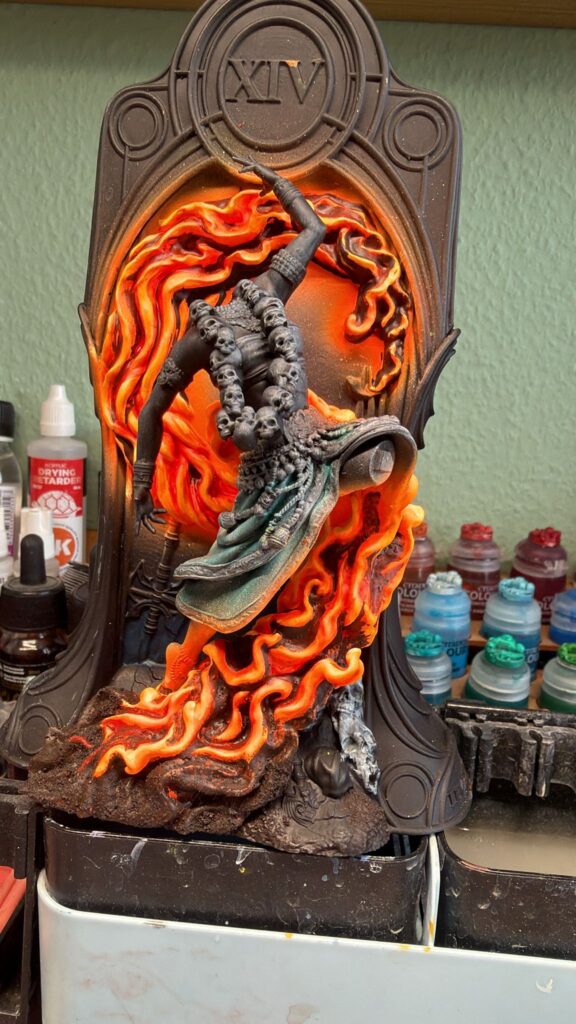
And then it finally clicked.
So I did what every slightly lost miniature painter eventually has to do:
I asked a friend.
Sometimes you simply need a fresh pair of eyes. Someone who has not stared at the same weird orange shapes for hours. Someone who is not emotionally attached to a bad idea just because they already spent time trying to make it work.
We brainstormed what exactly felt wrong, and finally, something clicked.
Maybe it was not fire.
Maybe it was lava.
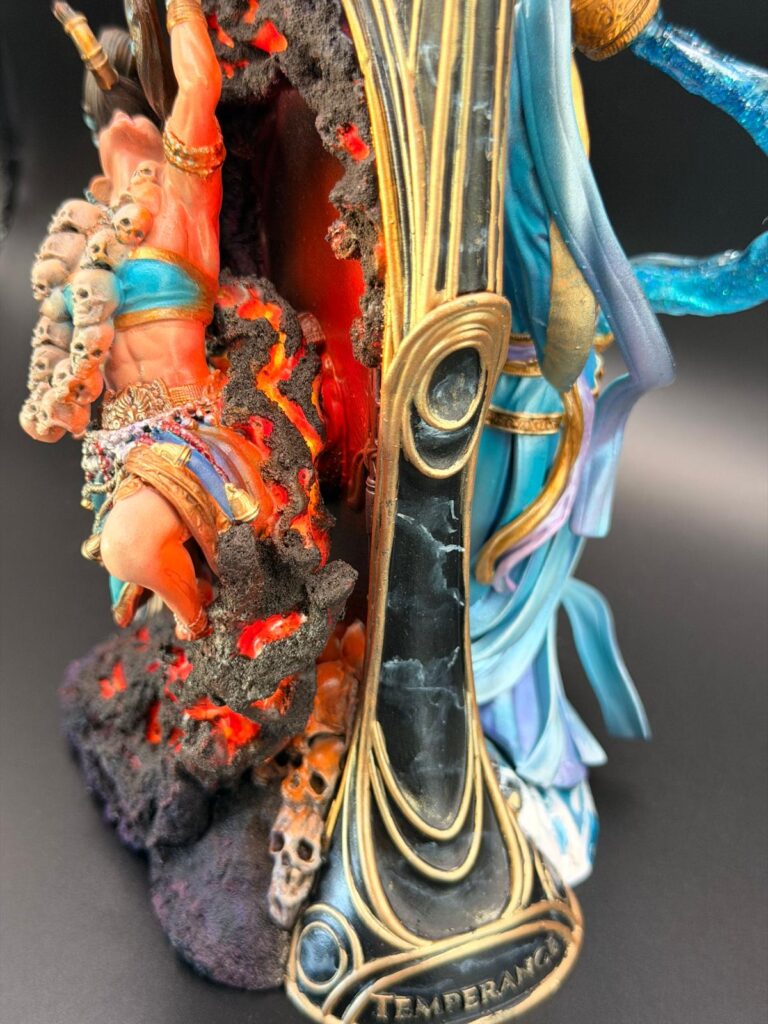
Not dancing flames, not elegant little tongues of fire, but heavy, glowing, dangerous lava.
Lava that is still darker and more solid near the ground, almost crusted over. Lava streams that become hotter and brighter as they move towards the centre of the card. And then a second flow of molten heat pouring out of the vessel in the middle, glowing intensely at its source and cooling down again towards the outside.
Suddenly, the shapes made sense.
Unfortunately, this also meant one tiny little problem:
I had still never really painted lava before.
Have I mentioned that already?
I admire Elminiaturista and his incredible ability to paint glow, fire, heat, and all those dramatic effects that look effortless when someone skilled does them. So I watched PDFs. I watched videos. I looked at examples. I studied transitions.
And of course, it all looked so simple.
Which is always the most dangerous part.
I bought what felt like every fluorescent paint and ink available on the market and started experimenting.
Layer after layer.
Glaze after glaze.
Bright colour. Darker colour. More yellow. More orange. More red. More contrast. Less contrast.
No.
Still no.
Absolute disaster.
So I painted everything bright white again and started over.
Because apparently that was my life now.
At some point, after enough failed attempts, something finally shifted. I got the idea of “fire” out of my head and started to understand the lava. The weight of it. The heat. The way the colours had to work against each other. The way the brightest areas needed to feel like they were glowing from the inside, while the darker parts cooled and hardened around them.
And once that clicked, the rest was no longer impossible.
Just very, very time-consuming.
There was a lot of glazing. A lot of careful adjusting. A lot of stepping back and asking myself: Is this still glowing? Is this too much? Is the lava stealing attention from the figure? Does the whole side still have enough room to breathe?
Because lava is dramatic.
Lava wants attention.
And I had to constantly remind it that this was still supposed to be a figure, not a tiny volcanic takeover.
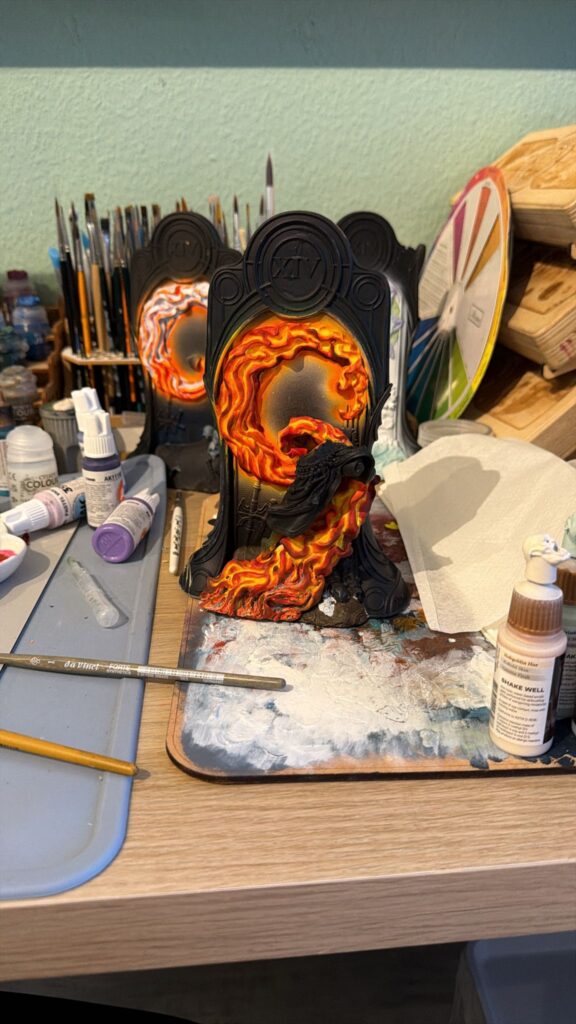

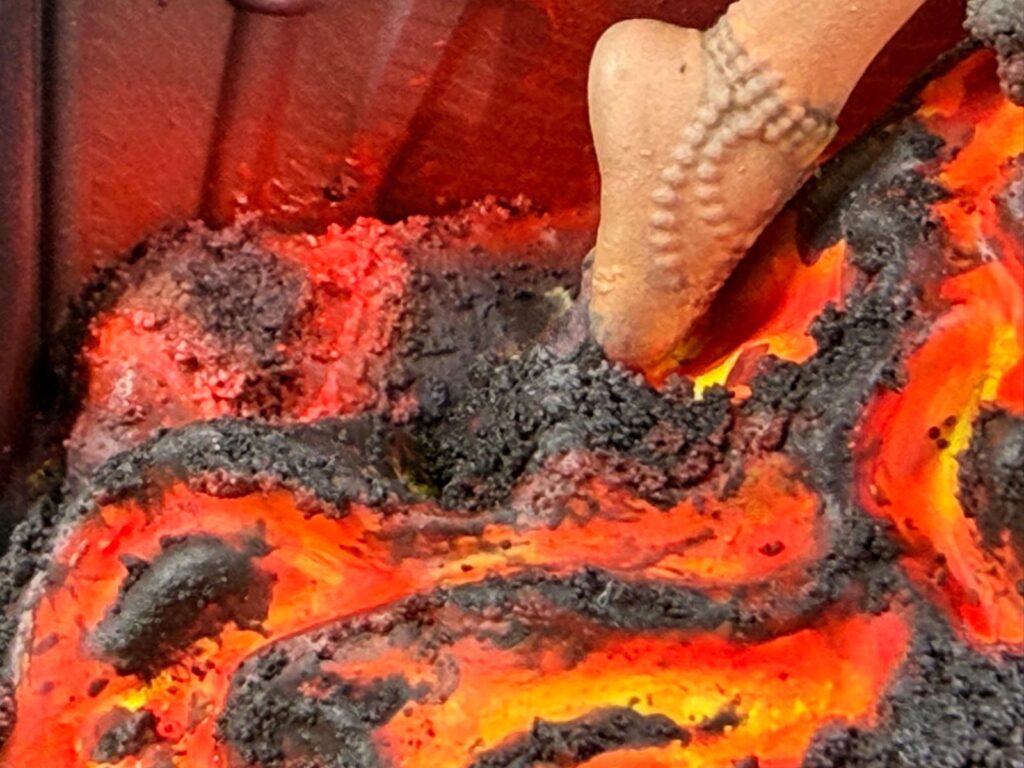
So I started covering the coldest areas with lava rock and worked my way through the whole thing bit by bit.
And that black volcanic rock was truly a game changer.
Suddenly, everything started to make sense. The contrast was stronger, the glowing parts looked more convincing, and the whole lava effect finally had something solid and believable to work against. It was no longer just bright colour everywhere. It had structure. Depth. Heat. Drama.
I loved the lava look.
But I still had to be careful not to let it turn into the previously mentioned volcanic takeover. Again and again, I had to pull it back a little, adjust, glaze, and remind myself that the figure was still supposed to be the star of the show.
The lava could be spectacular.
But it was not allowed to steal the entire stage.
And you know what?
Creating lava is actually a lot of fun.
Messy, time-consuming, occasionally nerve-wracking fun — but fun nonetheless.
Once I finally understood what I was trying to do, it stopped feeling like a battle and started feeling like actual painting again.
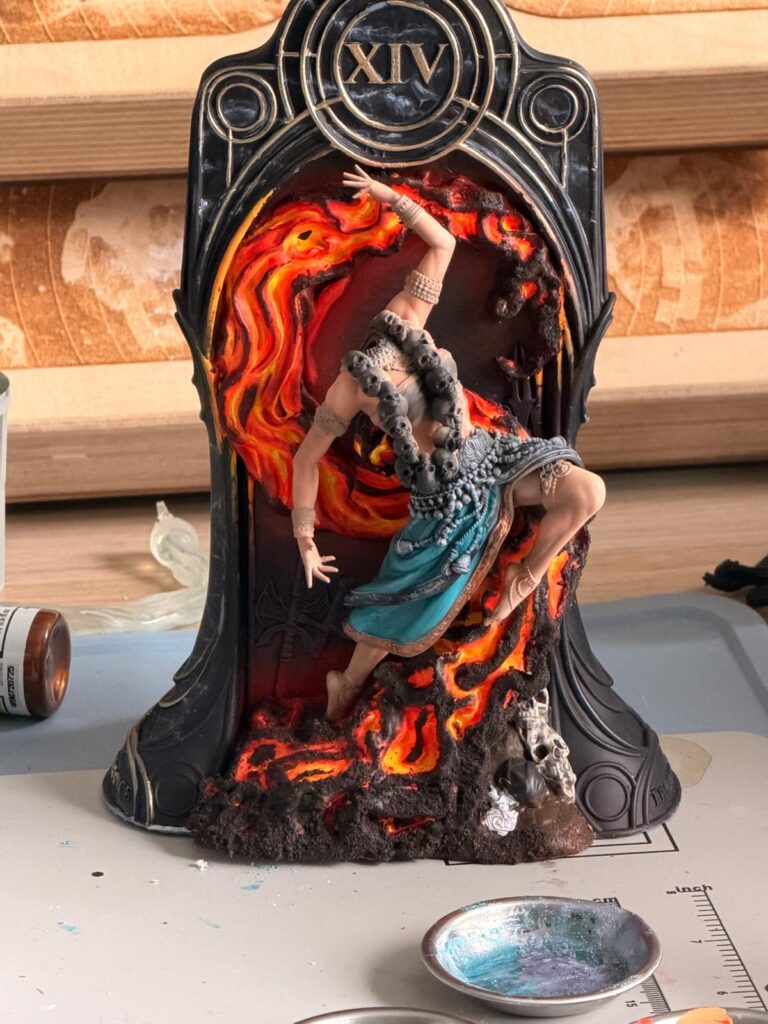
And the final effect was pure drama.
Exactly the kind of drama and energy I had wanted for this side from the beginning.
Once the lava finally worked, the figure itself was actually surprisingly quick and straightforward to paint.
Well.
Mostly.
Except for the OSL.
Of course.
Because naturally, the one thing still missing was another technique I had never really tried before.
Object Source Lighting. Glowing lava reflecting onto the figure. Warm light, believable placement, subtle intensity, not too much, not too little.
Easy in theory.
Terrifying in practice.
So I did what any sensible perfectionist under time pressure would do:
I avoided it until the very last day.
Meanwhile, just to make things a little more entertaining, the delicate earring broke off the head. And as mentioned in the post about the water side, this meant I had to print again anyway.
Because apparently this project was not complete without at least one more small technical disaster.
On the day of my personal deadline, there was still quite a lot to fix on the fire side:
The head had to be attached, which was already difficult enough because it did not exactly slide into place like it was trying to help me.
The OSL from the lava had to be painted, despite my very limited experience and my very strong desire to keep pretending it did not exist.
And I still had to find the right amount of liquid lava — enough to make the scene glow and feel alive, but not so much that the background completely overpowered the figure.
Again, balance.
Always balance.
The entire project had started with the idea of Temperance, and somehow even the painting process itself kept forcing me back to that theme. Too much lava, and the figure disappeared. Too little lava, and the whole side lost its energy. Too much light, and everything became messy. Too little light, and the drama was gone.
So there I was, on deadline day, trying to glue a stubborn head in place, paint my first real lava OSL, control the volcanic enthusiasm, and convince myself that this was all perfectly normal holiday preparation.
Other people pack sunscreen.
I paint glowing lava.
The Grand Final
So, about the OSL.
I first tried to paint it with a brush and fluorescent colours.
And please forgive me, but I did not take any photos of that disaster.
Some things do not need to be documented for future generations.
It was too harsh, too bright, too uncontrolled, and very quickly moved from “glowing lava reflection” to “what happened here and should we be worried?”
So I did the only reasonable thing.
I took out the airbrush, unpacked the skin tone again, and sprayed over it.
A reset.
A deep breath.
A small moment of pretending this had all been part of the plan.
Then I took one step back and changed the approach. Instead of attacking the figure with fluorescent colours, I used Burnt Red and Deep Orange and sprayed carefully with the airbrush from the outside inwards.
And suddenly…
Much better.
Not perfect, of course. Let’s not get dramatic in that direction. But so much better. Softer, warmer, more believable — and, to my great surprise, not nearly as difficult as I had feared.
After that, I watched even more videos, tried to absorb all the tips, and attempted to apply them without overthinking myself into complete paralysis.
For a first attempt, I was actually quite happy with it.
There is still a lot to learn, definitely. But the effect was there. The lava finally felt like it was casting light onto the figure instead of just screaming orange from somewhere nearby.
But why should everything go smoothly at the end?
That would have been far too easy.
It was shortly before midnight when I was finally at the point where I could varnish the figures. I was tired, very tired, and we had to get up early the next morning because we wanted to leave for our holiday.
The photos had already been postponed to the next morning.
I had cleaned the airbrush after using gold for the final corrections on the frame. Or at least I thought I had cleaned it.
Glossy varnish went into the paint cup. The spray booth was switched on, immediately filling the house with its very charming “wake everyone up at 50 decibels” soundtrack.
And off I went.
Unfortunately, I was too exhausted to test whether the airbrush was really properly clean.
Spoiler: it was not.
After about five seconds, I noticed it.
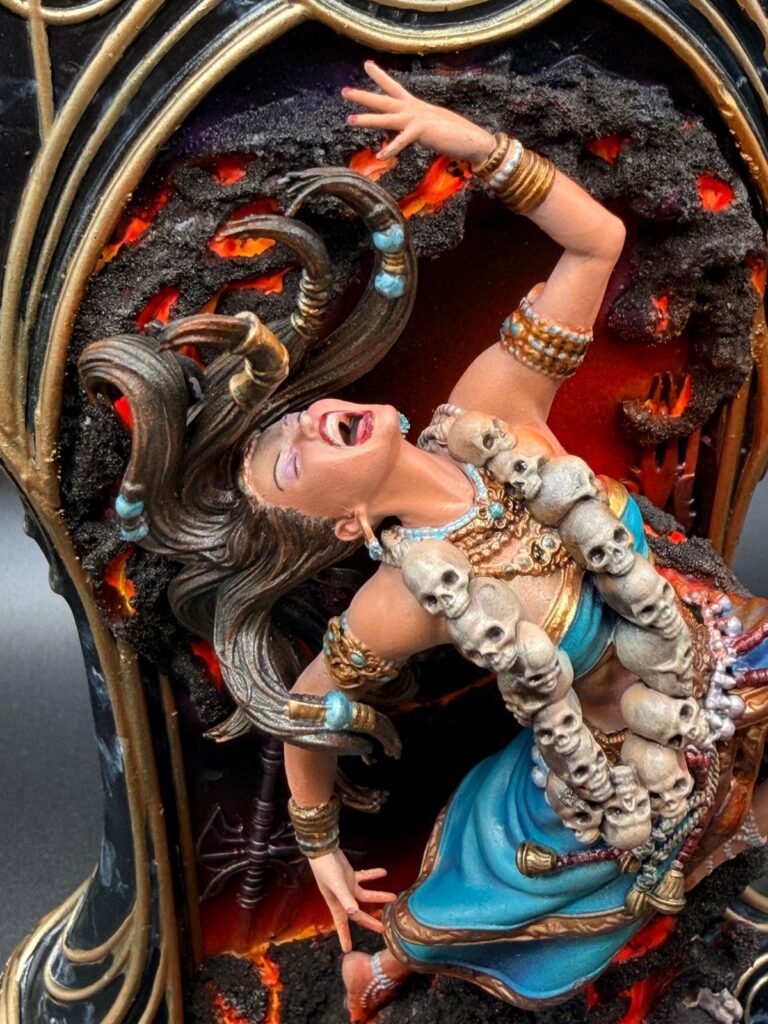
There was now a golden shimmer over the hair and the left side of the fire figure.
A golden shimmer.
At midnight.
After everything.
And by the time I saw it, it was already too late.
At that point, honestly, I was done. Completely. I could not fix it, I did not want to fix it, and I was absolutely not going to start another rescue mission in the middle of the night before leaving for holiday.
So I made peace with it.
Luckily, it was only a little shimmer. And strangely enough, it even gave the whole thing a certain glittery finish that does not look too terrible.
In fact…
Maybe it looks almost intentional.
Maybe.
Let’s just call it a special effect.
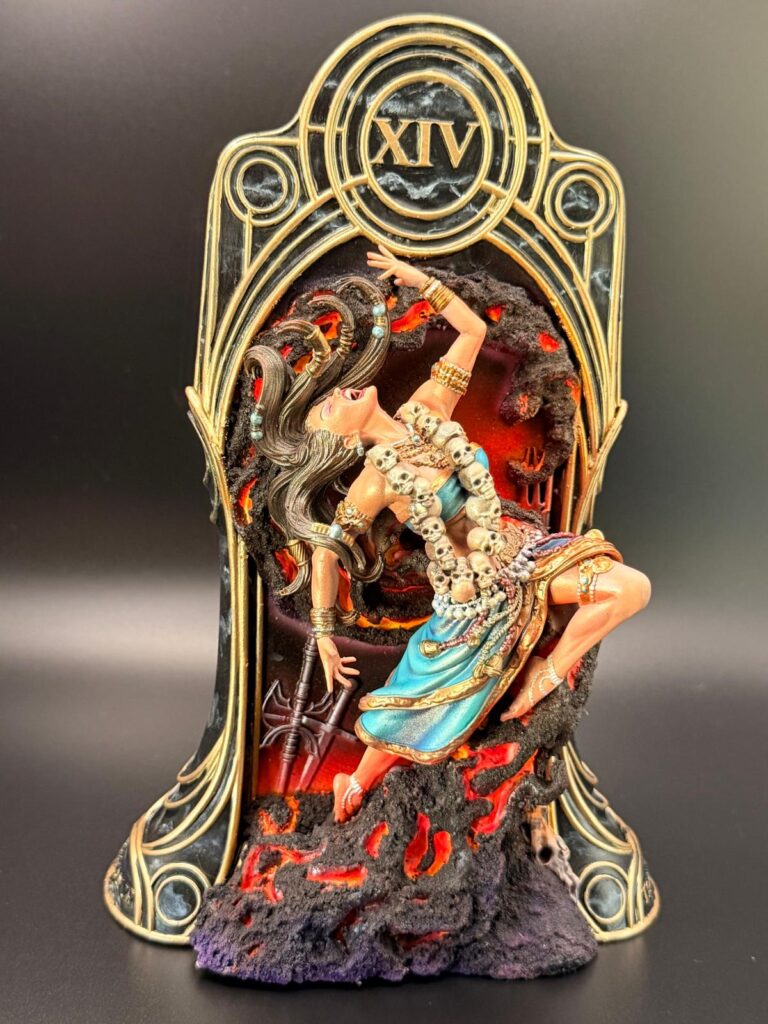
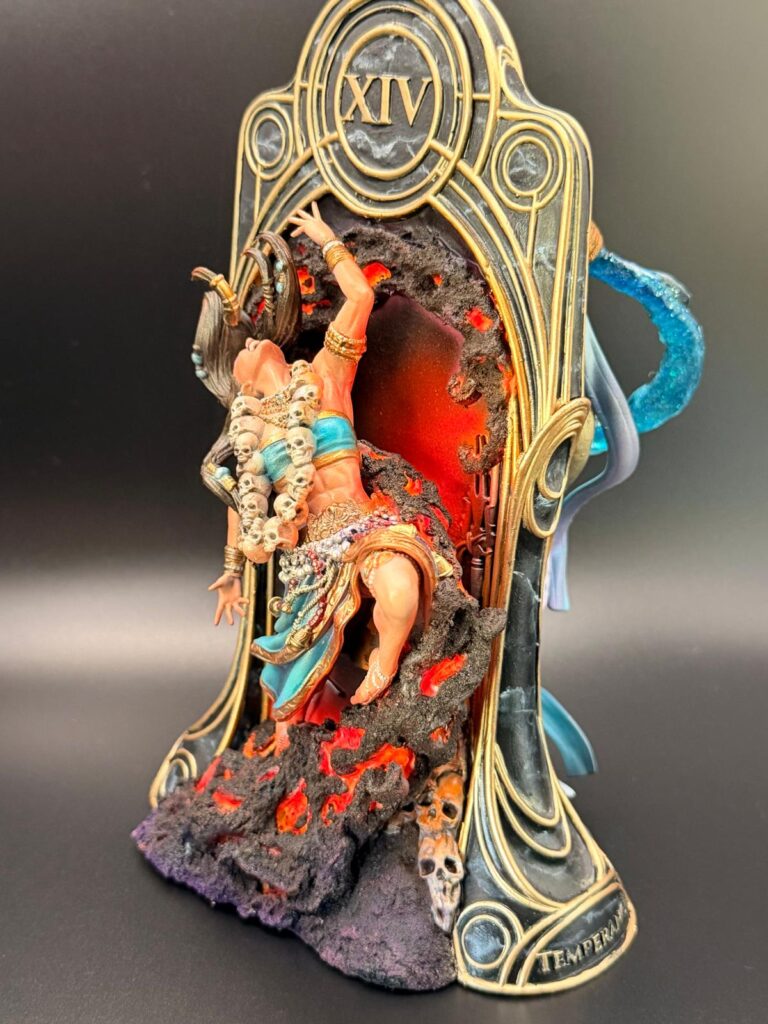
So here she is: my unexpectedly glittering fire — or lava — figure.